
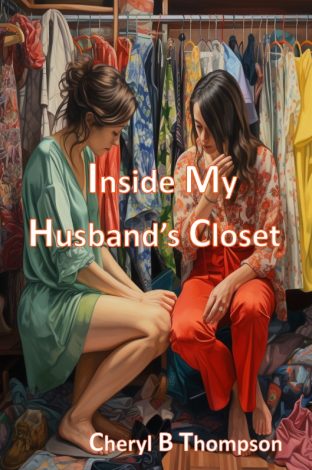
‘Inside My Husband’s Closet’ is a memoir written by Cheryl B. Thompson about her spouse and the journey they took, and are taking, together. Not only has she written a book, she also maintains a blog with other insights about their life together.
Earlier this year Ms. Thompson offered to answer questions about her experiences and perspectives about relationships and gender identity. I am excited and honored to share her responses here.
Thank you for submitting your questions and I hope you find her answers and thoughts helpful.
Thank you to Ms. Thompson for your time, your support, and thoughtful words!
Love, Hannah
I want to note that my wife has encouraged me to write this blog ever since I first
mentioned the idea to her. She has read all of what I have written. Her only changes
have been in grammar and for clarity.
When my husband first expressed a desire to cross dress it was during the Covid
pandemic, before the vaccines. He asked I not share this information with family or
friends. This left me with few resources other than talking with him or using references I
found online.
What I knew about cross dressers and transgender folks at that time had come from my
work in Student Affairs at a local university and attendance at several LGBTQ
conferences and webinars. As expected, this information was presented in an academic
rather than a personal fashion. The conversations were primarily directed toward what
the trans individual was experiencing, little was provided that directly related to allies.
One of the earliest non-academic resources I found was Hannah’s website. Her
comments helped me to understand some of what my husband was going through. Her
wife’s perspective in “Ask Hannah’s Wife” helped me to view things from my vantage
point.
Because of the value of Hannah’s blog in my early days as a cisgender wife I wanted to
be able to give back to others. I offered to share my experiences to those who are cross
dressers, and/or trans and their partners. Hannah kindly agreed to work with me on this
project. Thank you, Hannah.
Five years have passed since “Ask Hannah’s Wife” was published. Much has changed
in the LGBTQ community. In addition, my husband, now wife, has transitioned from
cross dressing part time to living full time as a woman. Thus Hannah’s journey has been
much different from that of my wife and I. Of the cisgender wives I have met, we have
many things in common, but we remain individual in our experiences and responses to
our partner’s change in gender identity.
My goal for this blog is to be helpful to this broader population, and those living in times
much different from 2019. The questions below were submitted by readers of Hannah’s
blog. Thank you for thoughts in guiding my discussion.
Note that I often put a number in parentheses after a given comment. This number
reflects how long since my wife had come out that I had this thought or made this
comment in my journal. I do this to give you a sense of the chronology over which
changes in my feelings occurred.
To simplify the narrative I use the term ‘trans’ to refer to a wide range of individuals who
may consider themselves cross dressers, trans, transgender, non-binary, queer, or use
another identifier to describe themselves.
Similarly, I use the term `wife’ to represent the cisgender partner in a relationship
regardless of their marital status. I tend to use female pronouns for my wife except for
events during the early part of her coming out when she still considered herself to be
male and a cross dresser. She didn’t begin to use the term trans until the 420th day after
coming out.
The questions Hannah provided me are identified below in bold.
Did you turn to any resources for support?
In the beginning my husband provided my greatest source of support. Prior to his
coming out he wasn’t known as a great conversationalist. But I pushed the issue. Each
week I took notes when a question or concern popped into my head. Then on Friday
night, after dinner and usually a bottle of wine, we talked. I read my notes and she
responded as best she could to my concerns.
I needed to know, to the best of his ability to respond, what exactly the changes she had
identified meant. Did he still love me; what did he see as our future; how often was he
going to dress; and on and on. Without his willingness to share his thoughts I wouldn’t
have been able to cope with these changes. His answers were not always extensive.
He’d often change his mind later. But just his willingness to try and give me an answer
and not shut me out was a tremendous help in adjusting to our new normal.
My search for information and support was severely limited by the presence of Covid.
Thus, most of my support came from the web. I initially searched on the terms ‘cross
dresser’ and ‘cross dressers wives’. Later I found that ‘transgender’ and related terms
were more fruitful due to a broader audience and changes in language that had begun
to occur.
The websites I found were primarily written by those who were cross dressers, trans, or
transgender. This baseline information was interesting and helpful, but didn’t directly
address my needs. Few, if any cisgender wives, maintained their own websites in 2020.
On some sites the authors intermittently mentioned their wives and issues they were
encountering. Others, such as Hannah, provided a single blog post authored by their
wife where she answered questions similar to those found here. In this same time
frame, Juliette Noir did two video interviews with her wife. I was comforted by her
perspective and the fact she didn’t have the same memory of their journey as did
Juliette. Marcie and I didn’t always agree either.
After a few months I identified several books that provided more in-depth information.
As with websites, those written by the cisgender partner were the most helpful. See the
bibliography at the end of this post for specific resources.
During the first month I sought out the assistance of a counselor. As others have
reported, I too was challenged to find a counselor with experience working with
transgender folks or their partners. I ended up sharing more information with him than
he had with me. He did provide me with standard coping mechanisms for dealing with
my overall stress, but nothing specific to dealing with a spouse who wanted to cross
dress. In the end, I attended just one and a half sessions before I ran out of questions
he could answer.
I attempted to reach out to organizations that might have been able to refer me to other
cisgender wives. I identified PFLAG, Fantasia Fair (Now Trans Week), Tri-ESS, and a
local Pride organization as potential sources. Unfortunately, because of Covid, websites
were not being kept up to date, emails weren’t being answered, and phone calls were
not returned. My employer had an LGBTQ resource group, but at this point my husband
had requested I not share his changes with anyone else.
In fall of 2021 we both attended Fantasy Fair, a conference for those who are
transgender and their partners. Being able to share with others going through similar
experiences was tremendously helpful. Just talking and hearing their suggestions for
coping was helpful.
After 16 months of “being out,” my wife became comfortable with me sharing with a
couple of my friends. Initially I was hesitant as I anticipated that because of my
professional experiences I might be more of a resource for them than they for me.
Slowly, I was able to pick friends who were helpful. All but one were geographically
dispersed. We used phone, text, email, and video chat to communicate.
Being able to talk with others was an immense help. I was surprised to find out that all
of them had friends or family who if not trans were within the LGBTQ community. Our
geographical isolation actually worked in my favor. I didn’t need to worry they would accidentally share my secret with others who knew me. While my wife’s coming out had
forced the two of us to learned how to better communicate, having female friends
provided a different and in some ways, more valuable source of support.
How did you overcome feeling alone/isolated in this?
As discussed in my online blog post “Isolation” (July 17, 2024), at the time my wife
came out everyone was isolated to one degree or another. Thus not only could I not
discuss her with others, but I also couldn’t meet my socialization needs within my usual
circle of friends. We were even separated from family who lived in the area until the
vaccine became available.
With no one with whom I could commiserate, my wife’s presence was my key resource
for addressing feelings of isolation. However, at times I felt even she wasn’t enough.
She would go days without talking about her struggles, leaving me to deal with my
loneliness by writing and internal reflection.
Surprisingly the strongest way to deal with loneliness was being with her. Unlike what
others have experienced, she rarely went out by herself. I went with her. Was this
comfortable for me? No, not in the beginning. But it got easier as time went on.
The biggest factor in my feeling of isolation was talking with or eventually being among
family members and not being able to talk about my wife’s changes. The need to watch
how I spoke about my wife was stressful. I also was bothered by the fact my family
didn’t recognize something was going on with me.
As I became able to talk with friends my sense of isolation eased. After we moved from the midwest to the south she came out full time and the instances where I had to “watch my language” were dramatically reduced. We live outside the city limits and haven’t yet met many within the LGBTQ community, so some sense of isolation continues. As before these feelings are managed by time with each other and time on the phone with friends.
Were there any words that your spouse used to help you understand this side of him?
Despite my asking him a myriad of questions in the first month, in the first year, and up until now after four years, I still don’t believe I completely understand this side of her well. She even admits that at times she is doesn’t totally understand herself. This side of her is not something she can put into words. Thus it hasn’t been her words so much as common experiences. She didn’t recognize the differences in her gender identity until later in life. She was uncertain of who she was. She’d not worn female clothes or used makeup before she came out to me.
Thus I got to watch as she learned these new things. She hadn’t decided how far out she wanted to come so I was able to watch as she made each small decision. Observation helped more than her words.
When we went out together at first it was not like a girls’ night out. I was with my husband but someone who was wearing a dress. His dressing created internal conflict but working
through it brought us together, regardless of how difficult it was.
If I was to reference words she used that helped me understand, even a little, they would be him saying:
He is attracted to the female body. He likes looking at other female bodies, large, small,
attractive, or not. He likes how female clothes feel on him.
This last comment was one of the more interesting things he said. I can put on jeans and a flannel shirt or a dressy dress and I don’t ‘feel’ any different. Silky material doesn’t do a number on me. I may notice the net in my body suit but not the fabric in my lingerie.
Even after 14 months I commented in my journal that while I knew we were on a journey, I didn’t know the destination or even the reasons for going. I didn’t understand him but I
was willing to tag along so we could learn together.
How did things change regarding intimacy?
While our emotional intimacy changed almost immediately due to our increase in
communication, changes in our physical intimacy came slowly. I firmly believe changes in the first (emotional) had to precede changes in the later (physical).
Early on when I asked her about the difference between her being a cross dresser and being trans she laughed and said, “about three to four years.” This is also about how long it took me to adjust to her as a woman in bed. The unfortunate news is that this was a long time, even though I was willing to change. The encouraging news is that it wasn’t as impossible as some might think.
While many women I have read have noted they’ve never developed a sexual attraction to their trans partner I believe we did a few things that facilitated my slow change.
Prior to my wife’s transition I openly admitted to her and myself that despite seeing her
external beauty, I felt no sexual attraction to her. This honesty was important so she had a
reasonable understanding of how I felt. She didn’t push me to adjust to her changing gender identity or set artificial deadlines for doing so. She let me take the lead.
When Hannah posed the question for this blog about changes regarding our intimacy I went back and reread my journal. Without my journal I might not have appreciated the subtle changes that occurred over time. Noting these changes helped me identify what we did that lead to success. These may not work for everyone, but I believe they helped us.
One advantage I had in developing an attraction to my wife was I had no underlying aversion to the idea of two women making love. Instead I accepted that this just wasn’t me. Thus I was working from a position of neutrality instead of working to dispel negative feelings.
During the first year, while I continued to regularly tell her I loved her, I rarely, if ever kissed her. I might on occasion give her a hug, but only one similar to what I would offer a well-known colleague.
The first time I made a conscious effort to pull her in closer I was surprised when she leaned away. To let her know her breasts didn’t bother me, I held her tighter. This time she didn’t resist. Later she said she was embarrassed because her breasts were not real.
Upon reflection I wonder if I should have let her know I was going to do, to give her a chance to say she wasn’t yet comfortable with this. While our communication on boundaries was mostly non-verbal, more dialogue may have been helpful. Each of us moved at a different pace in establishing a new sense of physical intimacy.
At two years we weren’t much beyond holding hands, light kisses, and deeper hugs when she was dressed. I believe a key reason I was able to move beyond this point was we never stopped making love as husband and wife. We didn’t disrupt our usual patterns of intimacy. We continued to use the techniques and strategies we’d use throughout our marriage. In addition, I never felt she was pushing me to go faster than I was comfortable. I’d never slept in lingerie so she didn’t either. This helped. I definitely preferred the sensation of warm, responsive, human skin to making a whole jump to sleeping with a woman in lingerie and silicone breasts.
The first time she wore her breast forms to bed was when she’d worn them all day she went to bed much earlier than me. Intimacy was not on the agenda that evening. Several times after that she proposed wearing her breast forms and dressing all weekend but she didn’t follow through. The first time she did so was on Day 628. Again, we didn’t make love that night.
She was giving me time to cognitively adjust to her changing gender identity. I also noticed she had begun to be gentler and more attentive to me in bed. I never asked if this was intentional, but I learned to enjoy these subtle changes. I interpreted them as a more feminine approach to making love.
While she never wore lingerie to bed, she regularly wore it around the house or on the deck at night. She immensely enjoyed wearing a sports bra and bikini bottoms, or other more feminine attire when at home. This was a way for her to enjoy the feeling of these clothes while I could slowly adjust to her more feminine side. She genially encouraged me to do the same.
As she dressed more at home, gradually became more affectionate. I often initiated this as I assumed she was afraid of pushing me too hard. When I recognized she was holding back, I suggested she initiate more small signs of affection. Her increase in such assured me she continued to find me attractive, essential to my ongoing adjustment.
The first time I felt any sexual attraction toward her was on Day 770 after a hair appointment. She came home looking different. Much more like a woman. This change sparked something in me I didn’t totally understand. After this, our love making changed. We moved between going to bed as ‘husband and wife’ and as ‘wife and wife’. We began to find many ways to please each other that didn’t depend upon either’s gender identity. During this transition she continued to assure me she didn’t mind if I was not sexually attracted to her, as long as we continued to make love in one way or another.
Initially things still felt strange. I wasn’t sure what to think of her chest. It was just silicone and I didn’t know how much she could feel from pressure. I didn’t know what she thought about my touching her breast forms. Did it make her feel more feminine even though she couldn’t feel the warmth of my fingers directly? I did noticed she was paying more attention to my breasts.
My sexual attraction developed slowly over the next couple of months. She asked me what had changed. I responded that I found it difficult to articulate, I just knew it was different.
We have continued to switch up our approach to making love. She has assured me
paying attention to her male side wasn’t creating any dysphoria. She even commented
that she enjoyed both approaches.
Successfully integrating my wife’s transness into our love life took patience and
understanding on both of our parts. Through this process we identified and learned a
variety of innovative approaches to showing our love for each other. The contents of our
toy box have expanded.
Was (or is there) anything you would like your spouse to know about how this side of them impacts you?
I’m taking the underlying meaning of this question to be not only what did I want my wife to know but what you (the reader) might want to share with your spouse. Because of whom I am, I have initiated conversation with her on a regular basis. So there hasn’t been a lot of how this side of her impacts me that we haven’t discussed.
The very first thing that hit me when my spouse came out were two fears. I was afraid he would leave me and I was afraid our love life would disappear. Neither happened. But since I was able to articulate my fears he was able to respond with behaviors that assured me they were unfounded.
Over time I recognized the significance of the question – ‘what was I afraid of?’ Your wife may not recognize what they are afraid of or the importance of the question. So ask her directly. My becoming comfortable with the word ‘fears’ and talking about them on many separate occasions was immensely helpful. Since I had defined them we could more easily identified strategies to relieve them and recognize when they had been banished.
The second thing I wanted him and now her to appreciate was how much I struggled with
understanding this attraction for dressing and later her feelings of being female. I’m an analytic sort and knowing why something happened or is happening makes life easier for me. Even her saying she didn’t/doesn’t know, or just saying it makes her happy has been more helpful than saying nothing. And as I’ve said above, every time I see how happy she is when dressed I understand just a bit more.
Third, uncertainty, inconsistency, and constant change have been and continue to be
challenging for me. Some of this may just be my being uncomfortable with not being in control in a situation. Although that’s not quite right either. I don’t need to control something, just need to be aware of what’s coming. She has learned over time to try and share with me any change she feels coming on as soon as she is able to articulate it. If I sense she’s contemplating another change and I don’t know what to expect this can negatively affect me.
Overall, the biggest impact of this side of her is that it is just hard work, both cognitive and
physical. Early on this was represented in time taken away from other things I wanted to be doing because I was helping her with things she needed to do such as finding clothes for her to wear.
Then during years two and three, the challenges were more cognitive. I found it difficult to be put into awkward positions because of my spouse’s malleable gender identity.
This occurred most frequently with discussions of the past. For example, on one occasion I mentioned to a new friend we had lived in Japan for two years in the 80’s. Her follow up
question was why Japan. My response, my spouse was in the navy. Her response was “huh”, women weren’t allowed in the navy in the 80s. Thus I was pushed into revealing my wife was trans. She had been a man in the 80s.
Needing to remember what pronouns to use for her and what noun I should use to reference our relationship was difficult. Was she my wife, husband, spouse or partner? Would someone I hadn’t met before be offended to learn I was married to a woman? Was this an isolated situation where I could lie about my wife’s gender identity to simplify matters, such as when interacting with a clerk in a store? She would say this shouldn’t matter, because she no longer cares. But I do. I’m not someone who can walk away from questions.
Thus I’ve had to do a lot of mental gymnastics to discuss my wife in a manner appropriate for the situation. Using ‘wife’, even after four years, still feels awkward at times. I have to
work hard at this and I feel bad when I mess up.
The last issue that impacted me, especially in the beginning, was adjusting to new roles.
Although this wasn’t an issue for us to any great extent, other cisgender wives have
expressed it as a concern. I’ve seen it where some trans women adopt the belief that if
they are now women they no longer need to do the male things around the house. Who
exactly is then supposed to do them? I’m a woman also. Some things I’ve just never
learned how to do.
As with everything involved with transition, communication, including negotiation are
essential. Being able to share the good parts of being a woman as well as the chores
typically assigned to the male helps reduce the stress of this change. For me the
biggest impact was not knowing which things she wanted me to do and which she
didn’t. Who opened doors, who did the driving? Some things were hard to negotiate
ahead of time because we hadn’t realized they would be an issue. A sense of humor
and not having either of us get bent out of shape helped immensely.
How are things today?
As I write this it’s been about 1400 days since she came out. That’s over four years, just
a little less than 10% of our married life. Having a strong marriage to build on made the
journey much easier, although it has by no means been effortless or always comfortable.
My journey has been made smoother by her acceptance of me and my responses. She
didn’t expect me to welcome this side of her immediately. She was patient, she didn’t
push, and even asked on occasion if she was moving too fast.
We have both had to work at adjusting. We talk a lot. The ease with which we now
communicate has been one of the most beneficial changes to come from her
transitioning.
The trip’s still has not always been painless. The alteration in her appearance
after facial surgery was the transformation with which I struggled the most. I wasn’t
expecting to see such a dramatic change. I needed over two months to adjust my
mental image of her. Yet, when I walk into a room now I recognize her. I smile. I’m truly
glad she’s my wife. But it took time and her willingness to give me that time that has
made it work.
This is not to say we don’t continue to have bumps along the way. I still have an
occasional day when I feel ‘unsettled.’ Although I’m not even sure what I mean by this. I
think these days are those when I think back to the past and try to deconstruct what has
happened. When I can’t remember or I don’t understand, my analytic brain causes me
stress.
She said upfront it would take three to four years to go from being a cross dresser to
living full time as a woman, and it has. I don’t know how this journey will look for those
who hid their gender identity for a long time. I can imagine there might be a greater
need to hurry up and get things done. That’s understandable when you’ve been waiting
so long. I do believe though that we have adapted better because we both took our
time, and accepted where we each were along the way.
Focused Bibliography
Crose, A. (2016, November 17). How my sexuality changed after my husband became my wife, HuffPost
GLAAD (2022a, February 28). GLAAD Media Reference Guide, 11th edition.
McKnight, H. (2022b, March 29). Change your gender, change your world, Part 3. En
Femme.
Thompson, C. B. (2024) Inside My Husband’s Closet, TransGender Publishing, Victoria BC, Canada. Thompson, C. B. (2024) Cisgender Voices
Ms. Thompson’s book can be purchased on Amazon.
 Hannah McKnight
Hi Hannah,
And a huge thank you to Cheryl.
I have to admit, I tend to struggle getting through some of the longer posts. This was like reading a fascinating book. The love really showed through.
The insight was fascinating, and I love their ability to communicate. My wife has known about this part of me since we were married over 40 years ago. Unfortunately for us it is out of sight, out of mind. We never talk about it. Sometimes that is really hard.
Cheryl I hope and your spouse have a long lovely life together.
Again thank you for opening up to us.
Jodi
LikeLike
This is amazing! I’m going to share this post with my wife this morning.
I remember when your wife answered questions on here… it was right about the time I was seriously beginning to explore who Alicia is, and I think my wife submitted a question or two.
Her, um, journey has been as profound as mine has been though all of this, and if I can be honest, I’ve fallen even more in love with her during it. I owe my wife so much, but have been so blown away by how much she has given me in this process.
Hannah, I shared something on my social media yesterday, and now I want to say it to you with emphasis (obviously I didn’t mention you by name in this post on social media):
“I just want to tell you, Hannah, to always remember that you are awesome, loved, and wanted!
There are many people whose lives are better DIRECTLY because you are in them 💗” . You just shared about two lives who have been directly bettered because of you, and I can tell you that there are plenty more!
Big hugs!
LikeLiked by 1 person
I think that the fact that she didn’t reject him as he was changing is amazing – fortunate to have a wife like this. I do also wonder if, as a man gets older, his female hormones become more dominant as his testosterone lessens and this is why a man’s female side becomes more dominant. Just wondering…
LikeLiked by 1 person