
Mirror image, see no damage
See no evil at all
Kewpie dolls and urine stalls
Will be laughed at the way you’re laughed at now
Now, something meets boy, and something meets girl
They both look the same, they’re overjoyed in this world
Same hair revolution, unisex evolution
Tomorrow, who’s gonna fuss?
-Paul Westerberg
I feel that, for the most part, we have come a long way when it comes to discussing gender over the last forty years or so. I mean, we have a lonnnnng way to go and sometimes it feels like we’ll never get past stereotypes and the fear, but it can be encouraging to look back.
In 1984 The Replacements recorded a song called ‘Androgynous’ and some of the lyrics are posted at the top of this article. At the time I wasn’t aware of the song or even aware of the band (despite both the band and myself being in Minneapolis) but this was incredibly progressive in an era when gender wasn’t commonly thought of as anything but binary.
I was eight when this song came out. By this time in my life I had seen a lot of instances in television shows and movies of men wearing girl clothes but it was always for laughs. As a boy who wore girl clothes it was a little uncomfortable realizing that people like me were meant to be ridiculed or shamed.
I wonder if hearing this song at that age would have encouraged me? I suppose that’s a topic for another post about the importance of representation.
I don’t remember the first time I heard ‘Lola’ by The Kinks. It came out in 1970 and the song is about a young man who falls for a woman who is very likely a transwoman or at least someone who is non-binary. I suppose it doesn’t matter? I mean, “boy loves girl” is the most common songwriting trope ever and details aren’t that important.
Unless when they are. ‘Lola’ isn’t just a song about a boy and a girl. Or is it? Ray Davies, the lyricist said of the song “It really doesn’t matter what sex Lola is, I think she’s all right”. I think him using the “she” pronoun is pretty telling, and pretty progressive, especially in 1970.
Anyway, I am not a music journalist and I am not going to lay out the history and public reception of the song here, but the Wikipedia article for the song is really interesting.
The song has garnered a little attention recently after musician Moby gave an interview where he said “the lyrics were gross and transphobic. I like their early music, but I was really taken aback at how unevolved the lyrics are.”
Based on the lyrics the song is about a boy who falls for a girl and then realizes that Lola isn’t cisgender. He is shocked, pushes her away, but in the end the heart wants what it wants, and his heart wants Lola.
I suppose if this song came out in 2026 I would be inclined to somewhat agree with him. I feel overall it’s a very accepting song, if that makes sense? Yes, the lyrics go back and forth between calling Lola a man as well as using she/her pronouns so it’s a bit all over the place… but maybe that’s intentional and part of the narrative? I mean, it’s not uncommon for someone to struggle a bit when they meet someone who is non-binary and choosing the right pronouns and terminology. It’s not always malicious or intentionally cruel.
As time marches on and as our thinking evolves, we look back on art and history through a modern lens. It’s fascinating to watch old cartoons, like OLD cartoons and see how racist they were and I am not defending them as they were wrong then and they are wrong now. But most of the time entertainment is in sync with the world’s sensibilities at the time. Seeing a cartoon character or a person in blackface is incredibly offensive today but there was a time when that wasn’t looked at as racist.
History is remembered in order to teach us. It’s growth to look back on what we did as individuals as well as a race to feel shocked and ashamed.
Is ‘Lola’ problematic? It’s a 56 year old song and yes, it’s not perfect. Was it progressive in 1970? I would say it was just as I think The Replacements song was progressive in 1984. Hell, I could probably be convinced that these songs are STILL progressive. As I mentioned, entertainment is often a reflection of what we as humans are thinking and what is acceptable but given how locked in people are when it comes to gender as a binary I would say these songs were almost revolutionary at the time.
Even if you feel revolutionary and progressive are a little generous to describe two classic rock songs, I hope you feel a little encouraged by them. I feel that they show an allyship and offer a little optimism for a future that I probably won’t live long enough to see. I do hope that gender specific things, like urinals and dolls, will indeed be laughed at in the future the way we are ridiculed now. I hope nobody will fuss tomorrow.
Love, Hannah
P.S. Of course this doesn’t even begin to cover gender and pop music. There’s some really transphobic stuff (looking at you, Funky Cold Medina), fun stuff like Pink Pony Club, and some subtle references, such as Tweeter and the Monkeyman. If you want more articles like this, please let me know in the comments.
 Hannah McKnight
Which part of Funky Cold Medina is worse? The transphobic part? Or the fact that its about a guy who thinks using the date rape drug is a great idea?
LikeLiked by 1 person
I don’t think it’s a contest. It’s a pretty horrible song
LikeLiked by 2 people
Tone Loc is also featured in Ace Ventura, one of the most transphobic popular films of all time. Coincidence?
LikeLiked by 1 person
Who knows? Everyone was punching down on the non-binary community in the 90’s.
LikeLiked by 1 person
Yes, more like this would be great!
LikeLiked by 2 people
Since you brought them up, it might be interesting to look at all the classic cartoons that feature cross-dressing. Bugs Bunny alone could fill two weeks worth of posts! (My fave would be “The Big Snooze”, in which it’s Elmer who gets the trans-treatment.)
LikeLiked by 1 person
I was always very impressed by Bugs Bunny’s feminine expression. He had a very lovely wardrobe and he had no hesitation in getting into full femme mode. I was so jealous of his makeup skills!
Angie
LikeLiked by 2 people
I think it is pretty apparent that Ray Davies was not a transphobe, the song is fun in a loving, warm-hearted way. Likewise, “Out of the wardrobe” (Misfits album, ca 1975?) is about a married crossdresser (or perhaps trans person), consistently referred to as “he” in the lyrics but obviously nontheless celebrated. Add some quite conservative gender roles into the mix and it sure feels a bit outdated. Is it a bad song because of that? I say NO , it just needs to be listened to and understood from the culture and understanding that applied at the time, half a century ago. The message is clear: the lad/lady is all right! And that is the important thing for me.
LikeLiked by 2 people
1970… I was a freshman in HS in a very conservative New Jersey suburb of New York City. I could not understand why God (in the guise of a church) would hate me for wanting to be different from “everyone else” (I was 13). The first time I heard Lola on the radio I felt understood. I was confused and all over the place (see above, I was 13) and could not decide if I wanted to be Lola or the song’s narrator.
Sadly, I feel our nation has taken many huge steps backwards. I’m 69 years old and I doubt I will live long enough to see some gains clawed back from the heartless goons currently running things.
Anyway…… thanks for reminding me of a great song that I need to add to my 1970’s playlist.
LikeLiked by 2 people
Hannah, I think your next steps are clear.
First: compile a comprehensive list of music that, in some way, references the gender non-conforming community. I’d be fine if you want to keep it to just 20th century songs.
Second: Classify each song with some kind of definitive rating that identifies whether it is positive or negative toward the community.
Third: Rank these songs based on a formula combining musical quality, cultural relevance, and non-binary supportiveness.
We expect this to be completed by the end of April. Thank you.
LikeLiked by 2 people
Lol… Shouldn’t be a problem, Hannah’s got tons of free time! 😘
LikeLike
I don’t know much but sometimes things can be over analysed… I just do me, in 20 years of going out enfemme all over the USA never had an issue except for a horny guy who wanted me ….It does piss me me off when I go to listen to some long forgotten pop music hits from years past on utube that these lame radio stations have to play the same shit too death.. don’t get me going on the modern screaming, pitchy pig stuck in a fence singing..
LikeLike
I googled that “Funky” song, heard it before, never knew who or where..can’t understand a word he’s sayn…
LikeLike
I think Moby needs to lighten up a bit….no he needs to lighten up a lot!
LikeLiked by 2 people
Very well said.
LikeLike
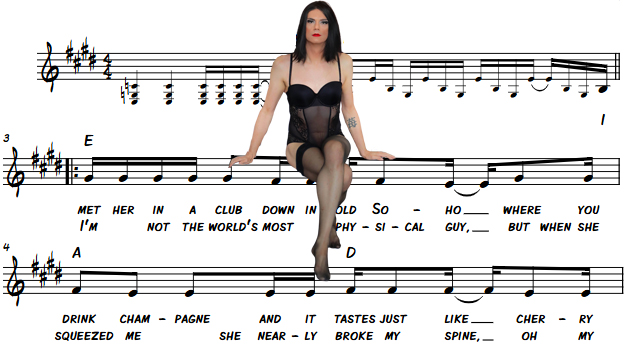
There’s been a lot of creative genius in your posts over the years, but you sitting on the sheet music to “Lola” looking absolutely stunning is the most brilliant thing you’ve done yet!
LikeLike
I was doing some work at my ex-wife’s the other night listening to the Hair Metal station and of course she came in when “Dude Looks Like A Lady” was on….
LikeLike
Don’t forget The Killers “Somebody Told Me” “Somebody told me, you had a boyfriend who looked like a girlfriend in February of last year”
Or Dude (Looks Like A Lady) by Aerosmith…
Girls and Boys by Blur…
Would the New York Dolls count?
LikeLike