
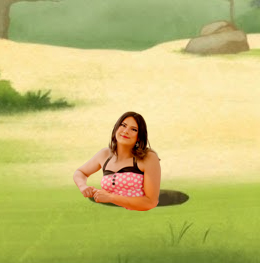
I never thought I would write about Bugs Bunny but here we are, I guess.
After reading everyone’s comments and emails about a recent post discussing gender in music, I was reminded of how important and universal gender representation in pop culture is/was during our formative years. We may have felt alone, but Lou Reed sang about plucking eyebrows and shaving legs and then he was a she so maybe we weren’t as alone as we thought.
For those of you who live under a rock, Bugs Bunny is a cartoon character from Warner Brothers. He first appeared in a cartoon called ‘A Wild Hare’ in 1940. Bugs Bunny is an agent of chaos. A rascally rabbit, if you will.
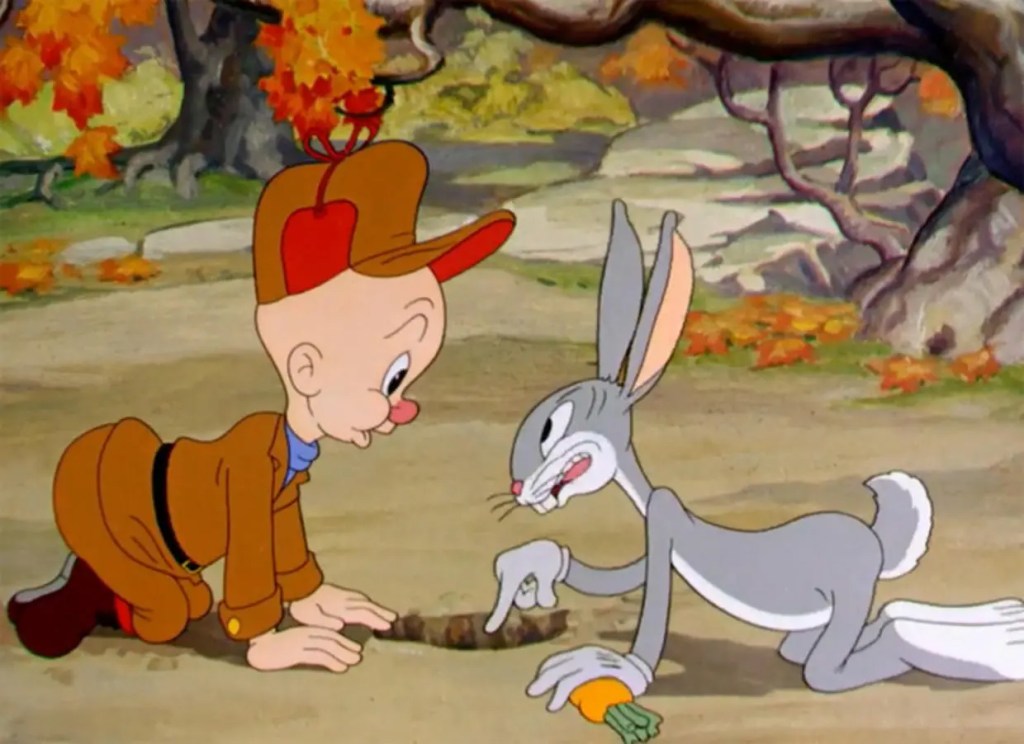
He is also gender-fluid. Of course, no one called it that then and we are not in a position to assign labels on someone else, let alone a fictional character, but he had no problem strutting out en femme when the occasion presented itself.
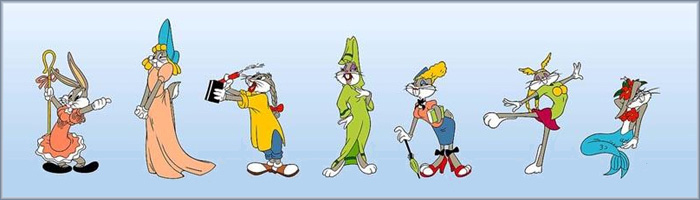
And my god, he looked amazing.
He gave me hope. I mean, if he could find high heels that fit those giant rabbit feet then I should be able to as well.
We all know that any sort of deviation of gender norms in a cartoon (and everything else) was/is played for laughs. Kids were meant to laugh at the boy who wore a dress and the bad guy was of course wearing pink underwear. I don’t think the animators were deliberately trying to say “gender non-conforming people are goofy” or whatever. They wanted to make kids laugh and they created things that kids would laugh at.
But at the same time, whether it was intentional or not, kids were learning (because they were being taught this) that boys wearing pink was funny, and when you are a kid, the last thing you want is to be made fun of. It’s not a surprise that boys became terrified of being associated with anything feminine.
If you were like me then you probably learned at some point that this secret that you have is one you had better protect with your life.
It’s not fair, right? When you’re five years old you shouldn’t HAVE to protect anything with your life, but that’s the way it is.
Anyway, Bugs Bunny got all dolled up to seduce Elmer Fudd or whatever and hilarity ensued. Bugs slipped on a dress when the story needed him to, and again, it was usually for laughs.
Buuut what stuck with me, through the implied shame and ridicule, is that Bugs Bunny seemed to LOVE it. He had SO much fun when he was in girl mode. Again, he and chaos tend to go together like a bra and panty. Crossdressing is part of his personality. It’s what many people think of when they think about Bugs Bunny. BUT I would argue (and yes, I KNOW that this is a cartoon character and a silly hill to die on) but I would say his love of getting dolled up is as much of his identity as anything else.
Bugs has been doing this since he first did it in the early 1940’s and that bitch is still doing it, as evident in recent cartoons. Something that I find funny is that if a cartoon character started appearing en femme in the year 2026 boomer lunatics would hop onto Facebook and complain to the other boomers that the cartoon was WOKE. But Ol’ Bigs has been rocking a dress for over 80 years.
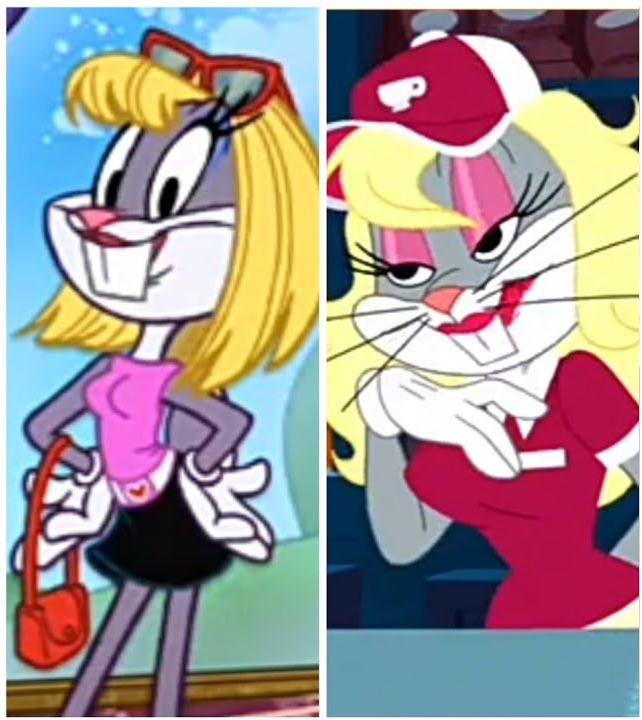
The question is WHY he had such an impact on us when we were growing up.
There’s two reasons. One, although Bugs Bunny cartoons are not the first time an audience was presented with a non-binary character (The title character in Orlando by Virginia Woolf, for example), most kids were probably not reading classic literature from the 1920’s. Television is much more accessible (and likely more attractive) to most kids growing up so for many of us the first time we saw a boy (albeit a talking bunny) wear girl clothes, was when Bugs did it
The second reason is that I would argue this was a positive representation for us. I mean, YES, it was played for laughs so it does lean into that stereotype of BOYS WEARING DRESSES IS FUNNY, but Bugs Bunny has SO MUCH FUN when he was en femme.
Sure, part of the fun was antagonizing the other Looney Tunes characters, but it seemed to be that Bugs really, really liked dressing up. He was having fun.
There was no sign of him being confused or anxious about it (I mean, this is a cartoon character for kids so it’s not like they were going to show him experiencing gender dysphoria). On some level, and this is what impacted me the most, he was showing me that yes, you can wear whatever you want and have fun and be you and not make it a big deal.
And yes, I know, there’s only so much you can do with a television show for kids, but I wasn’t thinking about that. He was never shown as feeling humiliated, he didn’t seem to care that others were seeing him wearing girl clothes. He just did it and to hell with everyone else. On some level he was even mocking gender roles. As a kid I didn’t know you could do that. I didn’t think anyone else saw the pointlessness of them. But Bugs Bunny did.
And again, I KNOW that’s not what the animators were trying to say, but as a kid that’s the message I took from it. It’s unlikely anyone, especially the animators, were thinking about non-binary representation when Bugs was rocking a dress, but like with everything else, kids learn all the time, even if no one is intentionally teaching them.
So, thank you Bugs. I know you will never read this (you’re a fictional character) but you made me feel a little less lonely.
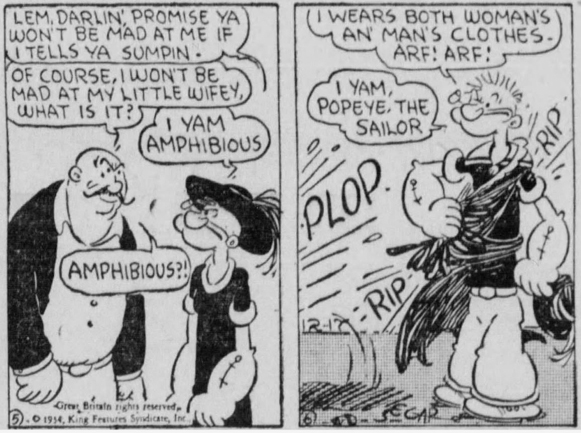
One more thing. I also have to acknowledge that Popeye did his part when it came to non-binary representation as evident from this comic strip from 1954. He didn’t understand the terminology and his heart was in the right place. No longer Popeye the Sailor Man, he’s just the Sailor.
Also, wouldn’t it be nice if we could eliminate all the nuances of gender identity and just be as succent as Popeye is here?
Love, Hannah


You never thought you’d write about Bugs Bunny? I’m honestly surprised that you haven’t done so sooner. I’m struggling to think of any character of the 20th century to have more cultural penetration while being openly genderfluid than Bugs. He’s an icon.
LikeLike
gosh, I’m amphibious too!
Although played for laughs, Bugs always offered a classy presentation, and yes, he/she expressed both happiness and even power/control.
LikeLike
Actually, the most successful feminine transition in a Bugs cartoon was probably done on Elmer! Take a look at “The Big Snooze”
https://www.youtube.com/watch?v=L07MFyHFqvg
LikeLike
Omigosh! Such a T-lightful read/article. Being a mature (ahem) girl I have been around to remember when Bugs was my afternoon best friend and Yes I think many of us share the idea that he was somehow and inspiration for she as well. Being a latch key kid I of course began experimenting with dressing at a fairly young age and even dabbling with lipstick and of course the ensuing guilt (Catholic). Keep in mind, (warning more history lesson to follow) prior to the Hays Codes starting in the mid to late 1930s female impersonators/entertainers (you know? Drag) were quite popular from the 19th Century to right into the Depression Era.
The moral superiority crowd showed up and started whitewashing everything from cleavage to hemlines to well the rest of us from the late ’30s into the 1950s and of course trans and homophobia were some of their favorite tools. That Bugs even got away with any of it is surprising not to mention where Milton Berle went with it!
As a Montana girl one of the more interesting stories along this line is that of Julian Eltinge who as a teenager appeared as a female entertainer in the saloons in Butte (1890s) during it’s heyday as a brawling mining town of the Old West! Later Julian became one of the highest paid entertainers on Broadway in New York! If ever in Butte you can visit the ‘Venus Rising’ coffee shop which celebrates the memory, talent and fame of Julian. Point being that anyone acting that ‘drag’ is somehow the degradation of ‘Murrica is just full of it and has a pretty poor depth of US history and entertainment.
LikeLike
Bugs was the preeminent example of the day but crossdressing was rife across many cartoons, from Tom & Jerry to Woody Woodpecker. There is no way this was just for laughs, the lengths that some of the characters would go to hints strongly that many of the creative people behind the productions had their own secrets.
LikeLike
Beautifully written! What a spectacular celebration of such an iconic symbol. I think even Elmer and Daffy would have appreciated it. Kudos!
LikeLike